Android · Windows · Linux · No account · No servers

Your messages go from your phone to theirs.Nowhere else.

PrivChat is a peer-to-peer messenger. There is no account to create, no phone number to give, and no company holding the conversation — including the people who made it. Two phones talk through Tor. That is the entire architecture.

✓ No account to create✓ No phone number✓ No analytics, no ads
9:41Tor · 2 hops
M
M.
fingerprint matches

Are you on a server I can subpoena, or not?

There is no server. It is still on my phone until yours answers.

queued · on this device

Then there is nothing to ask for.

delivered · 1h then gone
Message stays here if they are offline
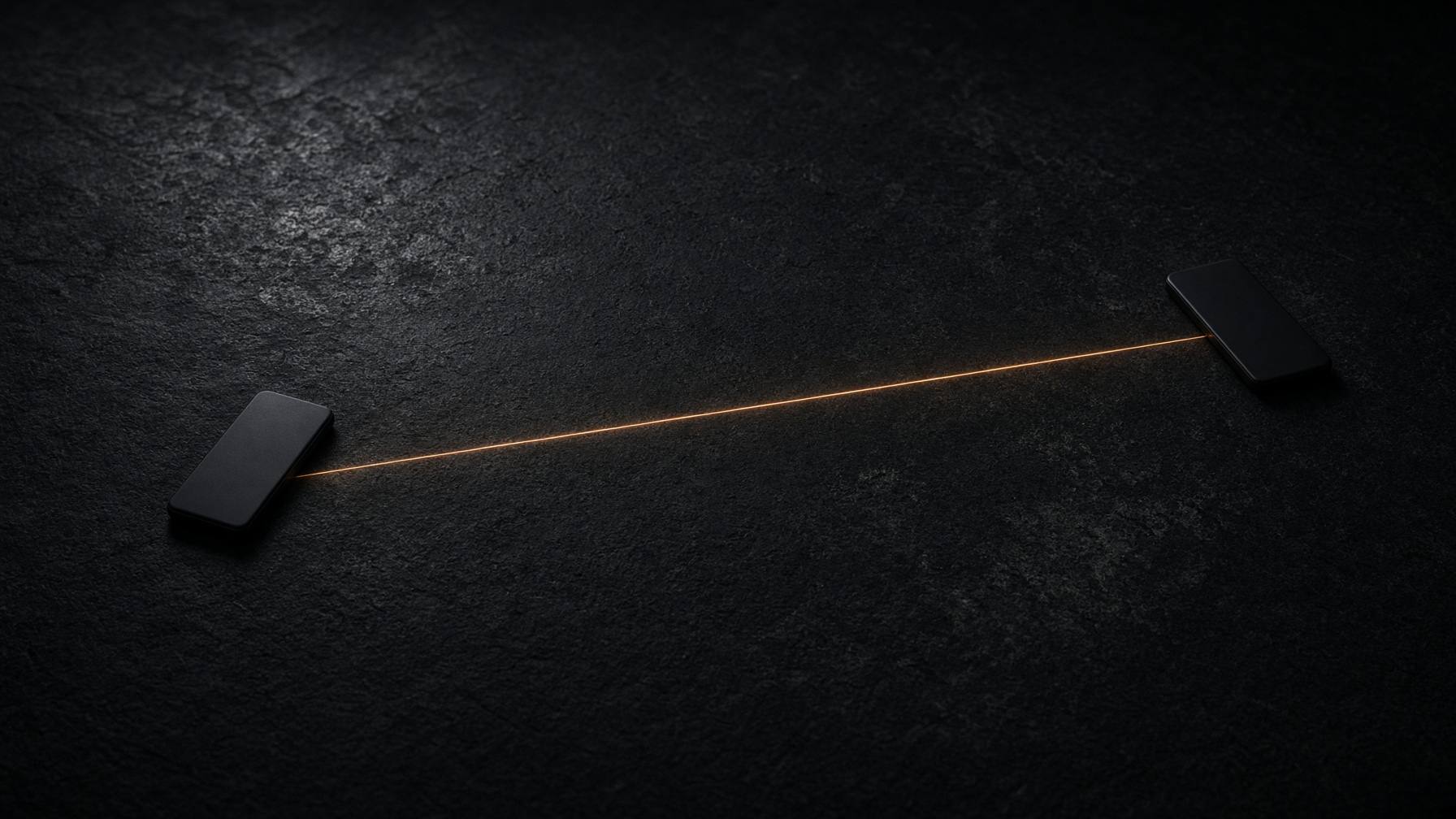
Two phones on a dark table, one line of light running straight between them and nothing else in the middle.

The record is the product

Most messengers are encrypted and centralised.

Your words are protected, but a company still sees who you talk to, when, and how often. That record is often more revealing than the words. PrivChat removes the company instead of asking you to trust it.

CriterionPrivChatWhatsAppTelegramSignalSimpleXToxBriar
Works without a phone numberYesNoNo ¹NoYesYesYes
Servers everything passes throughNoneMeta’sTelegram’sSignal’sRelays with no identityNoneNone
Who can know who you talk toNobodyMetaTelegram ²Signal, the minimumNobodyYour IP can leakNobody
Post-quantum key agreementYesNoNoYesYesNoNo
Post-quantum signatures and envelopeYesNoNoNoNoNoNo
Open sourceNoNoClients onlyYesYesYesYes

¹ Telegram allows signing up with an anonymous +888 number, which is paid for.

² Since 2024 Telegram hands IP addresses and phone numbers to authorities on a valid court order.

Checked in September 2026 against each app’s public documentation. These things change: if you see something wrong or out of date, write to us and we will correct it.

No serious messenger comes off badly here for weak encryption: they all encrypt well. The difference is what gets recorded outside your phone, and who has to keep behaving for that to stay true.

How a message travels

Phone to phone. The middle is other people’s relays, and they cannot read it.

  1. 01

    Your phone

    The message is encrypted before it leaves. Nothing readable crosses the wifi, the tower, or your provider.

  2. 02

    Tor

    A chain of relays, each knowing only the hop before and the hop after. Volunteers, not a company. The first does not know whom. The last does not know who.

  3. 03

    Their phone

    The key exists only on the two devices. If they are offline, the message stays on yours and tries again. Nothing is parked on a machine belonging to someone else.

9:41Tor · 2 hops
M
M.
fingerprint matches

Are you on a server I can subpoena, or not?

There is no server. It is still on my phone until yours answers.

queued · on this device

Then there is nothing to ask for.

delivered · 1h then gone
Message stays here if they are offline
YouGuardMiddleExitThem

Each hop knows one neighbour. Nobody in the chain holds the key.

Without internet

When the network is down, messages still find their way.

A blackout, a network shut down, a place with no signal. PrivChat does not just wait: it talks to the person in front of you without going through the internet, or puts your messages in a package that goes as far as someone carries it, or keeps them at home until you are back, or sends them over the radio to your contact's node. The same encryption, the same keys, and the messages land in the same conversation.

Local Wi-Fi · Bluetooth · tens of metres

In person

The same Wi-Fi, even with no way out to the internet, or Bluetooth. With no router, one phone creates the network and the other joins. You both turn it on on purpose, for one contact and for a limited time: the app never announces itself to anyone on its own.


USB · email · any channel · no distance limit

The package

Your messages, sealed in a file only the recipient can open. Save it on a USB stick or send it through any channel: whoever carries it cannot read it, and if it is tampered with, it will not open. From the outside it is shapeless bytes: it does not even say which app it comes from.

Home Wi-Fi · Tor, optional · always on

The Mailbox

PrivChat with no screen on a Raspberry Pi or a computer at home. When you are out, whoever comes by your Wi-Fi leaves your messages there and picks up the ones you left them; with internet, people can write to you with your phone off. It only keeps what is yours, sealed: it cannot read it.

LoRa radio · Meshtastic or MeshCore · kilometres

The LoRa mesh

A small radio next to the phone, linked by Bluetooth. With no internet and no coverage, your texts go out over the radio in pieces and other nodes repeat them for kilometres; your Mailbox with a node delivers them over Tor. Text only, and a few messages an hour. Whoever listens sees that a node transmits, not what or to whom.

Yousealed packagea USB sticktrusted handsa borderRecipient

It does not relay through strangers' phones or look for anyone: the same rule as over Tor. On the phone and on the desktop.

What an observer sees

Every packet is the same size. The app talks when you don’t.

A one-letter reply and a long paragraph leave the phone as identical envelopes. Decoy packets go out at random, indistinguishable from real ones. Toggle the conversation off: the line does not change its story.

An observer watching the connection cannot tell whether you are having a conversation at all.

Without decoys, bursts of packets track your typing. The words stay hidden. The fact of speech does not.

The line is quiet. That itself is a signal — which is why cover traffic is on by default.

captured packets len=512 · sealed
  • env24EAC785 · 587CAE42512 B
  • env9F10B3D6 · 6D3B01F9512 B
  • envC4772AE1 · 1EA27744512 B
  • env0B8E5C37 · 73C5E8B0512 B
  • envA6D209F4 · 4F902D6A512 B
  • env3E51CB88 · 88BC15E3512 B
  • envD72F604B · B406F27D512 B
  • env57A3E9C0 · 0C9E3A75512 B
  • no packets

Readable field: a random single-use key. The routing header is encrypted. The sender’s identity is not on the envelope.

What protects it

Layers, each solving a different problem.

A new key for every message

Keys are not reused. Each message is encrypted with its own, derived fresh and thrown away. If one key were ever compromised it would open one message — not the conversation. Once the two phones speak again, the chain heals itself.

The packets do not say who is speaking

Encrypting the words is the easy part; what leaks is everything around them. Each message is wrapped in a sealed envelope whose only readable part is a random single-use key. Since 2.2 that envelope is born from the conversation, not from your identity.

Every message is the same size

A one-letter reply and a long paragraph produce packets of identical size. The app also sends decoys at random intervals, indistinguishable from real ones. An observer cannot tell whether a conversation is happening.

Why it will still be safe in twenty years

There is one attack you cannot defend against after the fact.

An adversary can record your encrypted traffic today and simply store it. If, years from now, a quantum computer breaks the key exchange used in 2026, everything they stored becomes readable — retroactively, and there is nothing you can do about it then, because the recording already happened. PrivChat’s key agreement combines X25519 with ML-KEM-768, the post-quantum algorithm standardised by NIST in 2024. The two secrets are mixed, so an attacker has to break both.

  • 2.0 — Identity carries Ed25519 and ML-DSA-65. Invitations, member lists and channel posts carry both signatures, and both must check out.
  • 2.1 — A conversation stays post-quantum: a fresh ML-KEM secret travels in every ratchet epoch, spread across the padding of ordinary messages.
  • 2.2 — The envelope itself — the part that says who writes to you — changes with the conversation. Contact keys renew weekly and are used once.

What you say today is still worth protecting in fifteen years.

On your phone

The device is the only vault. Treat it like one.

Encrypted at rest

Messages, contacts, attachments and the keys themselves are encrypted with a key held in the Android keystore, tied to the device hardware.

PIN and panic PIN

A PIN means the key needs two halves: yours and the phone’s. A panic PIN wipes the identity and is indistinguishable from a normal unlock.

Ephemeral, then gone

Messages can delete themselves after an hour, a day, or a week. Erase identity destroys the keys, not just the files: old data is unrecoverable even with the phone in hand.

No cloud, not even yours

The app excludes itself from Android backups. Conversations are never uploaded anywhere, and photos are recompressed so GPS, model and date do not travel with them.

Groups

Two hundred people. No coordinator.

A message to the group leaves your phone once per member, over the same encrypted one-to-one sessions. The member list is signed by the admin, so nobody can be slipped in unnoticed. There is no server keeping the roster. Up to two hundred people; the app states the data cost before you join.

Channels

One publisher. Readers stay anonymous.

A channel has its own Tor address and signing key, unlinked from the publisher’s messaging identity. Readers fetch posts over anonymous circuits, so the publisher cannot tell who reads. Posts are signed and chained, so history cannot be rewritten in silence.

Start talking

Three gestures. Then it is just two phones.

  1. 1

    Install it. Open it.

    The first launch generates an encrypted identity on the device. Nothing is sent anywhere. No name, no number, no email.

  2. 2

    Invite once.

    Each invitation is a QR code that works for one person and expires. Share it only with them; their app fetches keys through Tor.

  3. 3

    Compare the fingerprint.

    Read the digits out loud. If they match, you are talking to the person you think you are — not to someone who intercepted the introduction.

Walkthrough, message states and first contact: How to use PrivChat.

Said plainly

The costs of having nothing in the middle.

Android, Windows, Linux and Mac. Not on iPhone yet: it is in testing and coming soon.

Both of you need the app. It does not federate with other messengers or SMS.

If they are not online, the message waits on your phone, unless you are nearby ("In person"), carry it by hand in a package, or you both have a LoRa node.

No calls, no video calls: Tor’s latency does not allow it. There are voice notes and video messages.

Cover traffic uses data — about a gigabyte a month if you leave it on.

Tor is slower than a company’s datacenter. That is the price, and it is the point.

Under the hood

Removing the server is not a feature bolted onto the encryption. It is what makes the encryption worth having.

Nothing here is home-made. Every piece is a public standard, and the links go to the specifications themselves, not to us. Current release: 2.15.0 on Android and 1.7.1 on desktop.

Architecture

Peer-to-peer: each phone is its own Tor v3 onion service, with no server in between.

specification
Key agreement

PQXDH — X25519 combined with ML-KEM-768 (FIPS 203).

specification
Key renewal

Double Ratchet with encrypted headers and ML-KEM-768 in every epoch. Prekeys renewed weekly.

specification
Message encryption

ChaCha20-Poly1305 (RFC 8439).

specification
Signatures

Ed25519 and ML-DSA-65 (FIPS 204). Both required.

specification
Key derivation

HKDF-SHA256 (RFC 5869).

specification
PIN derivation

Argon2id (RFC 9106).

specification
Local database

SQLCipher, AES-256 (FIPS 197).

specification
Transport

Tor, via the arti implementation.

specification

Questions

Before you install.

Do I need a phone number?

No. The first time you open the app it generates an identity and stores it encrypted on the device. Nothing is sent anywhere. There is no account to create.

What if the other person is offline?

The message stays on your phone and retries later. A queued state is not a failure — it means they are not reachable. There is no cloud inbox holding it in the meantime. With a LoRa node, texts go out over the radio: they take minutes, not seconds.

Is there really no server?

Each phone runs its own Tor onion service and speaks to the other one. PrivChat does not run a relay, a queue, or an account database. Tor relays pass sealed packets; they do not hold your conversations.

Can someone watching my network see that I am chatting?

They can see that you connect to Tor. They cannot read the words. With cover traffic on — the default — packets of identical size go out whether you are writing or not, so they also cannot tell whether a conversation is happening.

Why post-quantum now?

Recorded ciphertext can be stored for years. If a future machine breaks today’s key exchange, those recordings open retroactively. Mixing X25519 with ML-KEM-768 means both have to fall. Signatures, envelopes and contact keys were brought along in 2.0–2.2, so the whole conversation stays closed.

Is it free? Are there ads?

Free, no ads, nothing collected to sell. Optional donations are Monero and Bitcoin Silent Payments, so a public chain does not become a list of people who support an encrypted messenger.

Is there an iPhone or Mac version?

Mac, yes: PrivChat is on Android, Windows, Linux and Apple-silicon Macs. iPhone, not yet: it is in testing and coming soon. Both people need the app; it does not talk to WhatsApp, Signal, or SMS.

Get it

Two phones. Nothing in the middle.

Free on Android, Windows and Linux. No account, no ads, no company to trust with the graph of your life.

A sealed envelope: the message as a closed packet nobody along the way can open.

Support it

Free, no ads, nothing collected to sell.

These are the only two addresses. Check the fingerprint in the app against this page before you send anything: rebuilding a binary with a swapped address is the classic fraud. The same fingerprints are published as a signed statement.

Monero

XMR
45hRduLUQD5Ek4qGgHTuWAZnncwroMET1WsLUDC9AF6DNSt5qMP1Fk7WUsN4EwzJdA1ypfL7TtJQQ8uqutAJWwJy5jzp8Pa

fingerprint 1D63 68D5 7653 1887

Bitcoin Silent Payments

BIP-352
sp1qqf2jvtz0k7rsy7f0cka9ejz6e4lmakz6v9zgae02ks0qpck3a6dxzqn73fp9gj6y632q8th2nfv2lv7rua49s5unzjpau3ahp29ssw689vwu9ksy

fingerprint 63BB FA03 F806 BC55

There is no ordinary Bitcoin address. On a public chain every donor would pay to the same place, visible forever: a list of people who support an encrypted messenger. Silent Payments derive a fresh destination per payment, so the chain does not assemble that list.

PGP BC8D E53F D8D1 6F63 AD8A 33EA 10EC 8069 37D6 8502 · donations.txt · public key